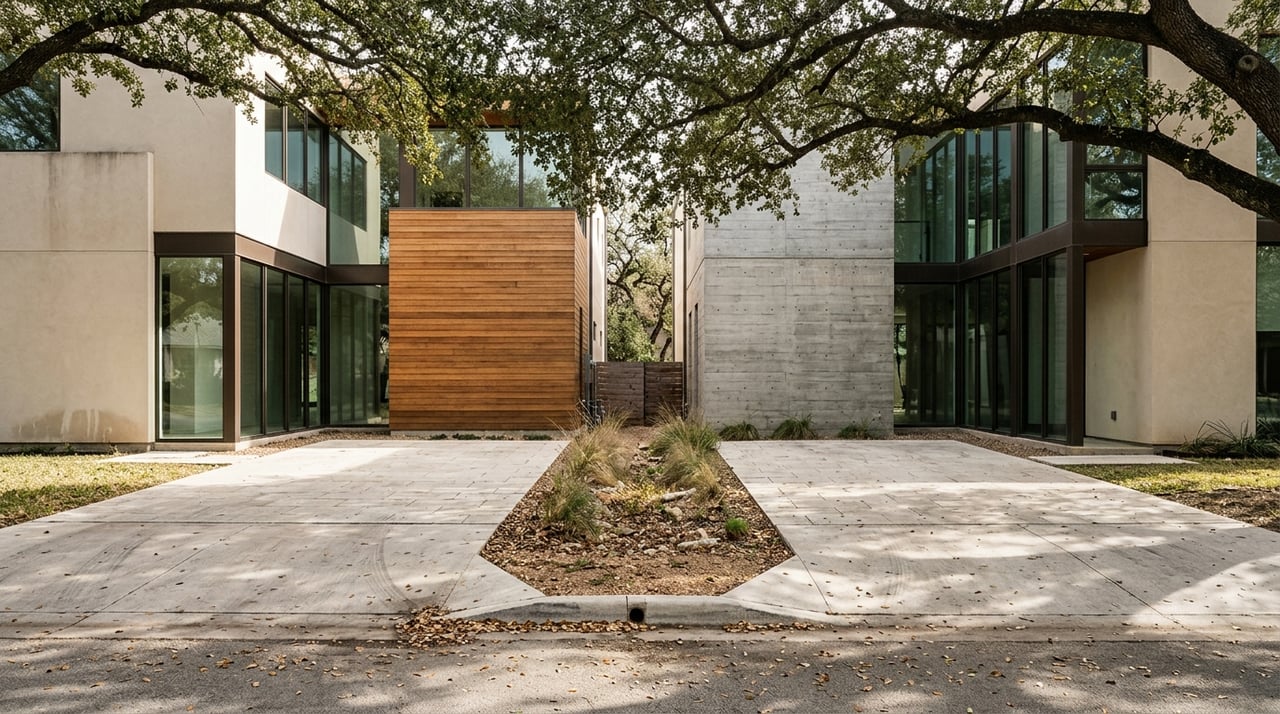
Wondering if buying two side-by-side lots in West Lake Hills automatically gives you one bigger, more flexible homesite? In this market, the answer is usually more complicated than buyers expect. If you are considering adjacent lots for a custom home, a long-term land hold, or a future redevelopment play, it helps to understand how zoning, plats, utilities, and access work before you write an offer. Let’s dive in.
Why adjacent lots need extra scrutiny
In West Lake Hills, adjacent-lot purchases are not just about acreage. The bigger question is whether the parcels, as recorded and regulated, support your intended use.
The city publishes zoning, mapping, wastewater, and subdivision guidance, and it points property owners to official maps and zoning determinations when parcel status is unclear. That matters because two lots sitting next to each other may still function as two separate legal lots unless a recorded plat action says otherwise.
Start with ownership and lot status
Before you focus on design potential, confirm what you are actually buying. Appraisal records, deed records, and recorded plats each tell a different part of the story.
Travis CAD is useful for parcel and appraisal data, but it does not replace title history. For adjacent lots, you also want to review Travis County Clerk real property records to trace deeds and identify any recorded documents that affect use.
Review deeds, plats, and easements
Recorded deed restrictions, restrictive covenants, and easement documents can shape what you can do with the site. West Lake Hills also requires those materials in plat submittals, and easements must remain accessible.
That means a lot combination may look simple on a map but still run into limitations from drainage, access, or utility easements. If you assume the lots can be treated as one buildable site without checking the record, you may be making a very expensive guess.
Confirm city limits or ETJ status
You also need to know whether the parcels are inside West Lake Hills city limits or in the ETJ. The city notes that ETJ parcels may still be subject to city subdivision rules, along with county and utility requirements.
That can change your approval path and your timeline. For edge-of-city properties, city approval may not be the only step needed for development feasibility.
Zoning drives the real opportunity
In West Lake Hills, zoning often determines the upside more than lot count alone. Buying two adjacent parcels does not guarantee expanded development options if the zoning district, minimum acreage, or lot shape still limits what can be built.
For many buyers, this is the point where a promising idea becomes either a clear opportunity or a clear no.
Understand the main residential districts
R-1 is a one-family residential district and allows one family dwelling per lot. R-2 is limited to preexisting properties and annexed areas where one-family or two-family units previously existed, and vacant land is not eligible for that district.
R-3 works differently. It is a transitional district intended to buffer nonresidential and R-1 areas, and clustered or detached single-family homes may be allowed only when specific adjacency, perimeter-contact, and centralized municipal wastewater conditions are met.
Minimum acreage still matters
The city’s dimensional regulations set minimum acreage at 1 acre for R-1 and R-2 and 2 acres for R-3. That sounds straightforward, but total acreage is only part of the analysis.
Lot width is measured along the front setback line, so an oddly shaped combined parcel may still fall short in practice. In other words, two adjacent lots can add up on paper and still remain constrained by geometry.
Impervious cover can limit design
For single-family residential lots, the city FAQ states that impervious cover is generally capped at 25% for lots of 0.5 acre or larger. Smaller lots can involve other formulas and wastewater-related bonuses.
Even if you can combine or replat adjacent lots, setbacks, height, and lot coverage can still narrow what a final site plan can support. That is why it is smart to study the regulatory envelope early, not after closing.
A larger homesite may require plat action
One of the most common misunderstandings in adjacent-lot deals is assuming common ownership automatically solves the legal-lot issue. In West Lake Hills, recorded plats and any later plat action determine whether the site remains two lots, has been formally combined, or needs a new application before construction.
That is a major distinction for anyone planning a custom build or a redesigned homesite.
Know the platting pathways
West Lake Hills regulates land division through plats, minor plats, replats, amending plats, and plat vacations. The city also requires a preliminary conference before filing an amending plat, replat, minor plat, preliminary plat, or final plat application.
If your goal is to merge lots, shift boundaries, or create a cleaner building envelope, that process can become part of your acquisition plan. It is not just paperwork. It can directly affect timing, cost, and certainty.
When a minor plat may work
A minor plat is limited to four or fewer lots. It may not require new streets or extensions of municipal facilities, and the lots must already be served or serveable by required city utilities with access from an improved public street.
For some adjacent-lot scenarios, that creates a manageable path. For others, especially where utilities or access are incomplete, a minor plat may not be available.
Replats can involve public notice
Replats may trigger mailed notice to owners within 300 feet of the lots being replatted. West Lake Hills ZAPCO also reviews subdivision applications, replats, amended plats, and minor plats in public meetings.
That does not mean a replat is a problem. It does mean your timeline should account for review steps, notice requirements, and the practical reality that lot assembly is often a public process.
Utilities and access can make or break feasibility
In West Lake Hills, utility service and access are often just as important as zoning. A parcel that looks attractive on a map can still become difficult if water, wastewater, driveway placement, or easement constraints are not favorable.
This is especially true on hillside properties, where site design and infrastructure often go hand in hand.
Check water and wastewater first
According to the city’s utilities information, water service is provided through Travis County Water District 10, while wastewater service is handled through the City of West Lake Hills. The city also provides wastewater connection manuals, fee estimates, and approval contacts.
If centralized wastewater is important to your build concept, confirm that status early. Some zoning and design scenarios depend on municipal wastewater capacity, not just lot ownership.
Septic status changes the equation
If a parcel is not on central wastewater, the city’s OSSF and wastewater guidance shows that septic review and permitting become part of the analysis. Residential septic pump-out timing also differs depending on whether the property is in the Edwards Aquifer Recharge Zone.
For buyers assembling adjacent lots, this can affect both cost and design flexibility. It is another reason to treat utility verification as an early due diligence step, not a late one.
Access must be direct and workable
The city’s subdivision checklist states that all lots or units must have direct access to a public street. It also states that curb cuts need city approval, drainage easements may not be obstructed without approval, and site data must show driveways, ingress and egress, drainage, and utility connections.
The same checklist notes that driveways are limited to undeveloped slopes below 25 percent gradient. On steep sites, driveway feasibility alone can influence whether a two-lot assembly works as planned.
Topography can reduce the practical upside
West Lake Hills lots often come with beautiful terrain, but slope can complicate design and approvals. Even when zoning and acreage look favorable, difficult topography may narrow the buildable area.
The city’s dimensional schedule notes that nonresidential development is not permitted where slope gradient exceeds 25 percent, and height and setback rules can become more restrictive on challenging sites. For residential buyers, the practical lesson is simple: not every extra acre adds equal usability.
A smart due diligence workflow
If you are evaluating adjacent lots in West Lake Hills, a structured review can save time and reduce surprises. The goal is to answer the zoning-and-platting question first and the design question second.
Here is a practical workflow based on the public record:
- Verify jurisdiction and zoning using the city maps and the Austin GIS jurisdiction map.
- Pull the deed chain, plats, and easements from Travis County Clerk real property records.
- Check Travis CAD for parcel and appraisal data.
- Review the city’s subdivision checklist, zoning code, dimensional regulations, and use rules.
- Confirm water, wastewater, and septic status with the relevant local utility and city departments.
What this means for buyers
If you are buying adjacent lots in West Lake Hills, think beyond the headline idea of “more land.” The real value lies in whether the parcels can legally and practically support your intended homesite, layout, or future development plan.
In this market, the public record usually answers that question more clearly than the listing description or purchase contract. A careful review of plats, zoning, utilities, easements, and access can help you avoid overpaying for land that does not perform the way you expect.
If you are weighing an adjacent-lot purchase in West Lake Hills and want a clearer read on the opportunity, Courtney Hohl can help you evaluate the zoning, lot configuration, and land-use considerations that matter before you move forward.
FAQs
What should you check before buying adjacent lots in West Lake Hills?
- You should confirm ownership, deed history, recorded plat status, zoning, easements, utility service, access to a public street, and whether the parcels are inside city limits or in the ETJ.
Does buying adjacent lots in West Lake Hills automatically combine them into one lot?
- No. Common ownership alone does not determine legal-lot status. Recorded plats and any required plat action decide whether the property is formally combined or still functions as separate lots.
What zoning issues matter for adjacent lots in West Lake Hills?
- Key issues include the zoning district, minimum acreage, lot width measured at the front setback line, impervious cover limits, and whether centralized municipal wastewater is available where required.
Can a replat be required for adjacent lots in West Lake Hills?
- Yes. If you want to change lot boundaries, combine lots for a new homesite, or otherwise alter recorded lot status, a replat or other plat action may be needed depending on the facts.
Why are utilities so important for adjacent-lot purchases in West Lake Hills?
- Water, wastewater, septic status, drainage, and driveway access can all affect whether the lots are practically buildable and whether your intended use is feasible under city requirements.