You can fall in love with a West Lake Hills lot at first sight, then discover the rules that decide what you can actually build. Zoning, slopes, and tree protections shape every design choice here, from your driveway grade to your roofline. If you understand the limits early, you can buy with confidence and shape a project that clears review. This guide gives you the key numbers, documents, and checkpoints to evaluate any lot before you write an offer. Let’s dive in.
Zoning basics for West Lake Hills
Most residential buyers will encounter the R‑1, R‑2, or R‑3 districts. These zones have different minimum lot sizes and minimum floor areas, with R‑1 and R‑2 generally at 1 acre and R‑3 at 2 acres. Setbacks and some floor‑area minimums change by lot size, so the schedule is your first stop. Review the City’s dimensional schedule for lot size, setbacks, height, and impervious cover rules in one place in the City Code schedule.
Height rules on sloped lots
District height caps are listed in the schedule, such as 30 feet in R‑1, 25 feet in R‑2, and 30 feet in R‑3. On steep sites the City applies a stricter measurement rule. If the average natural slope under the structure is 25 percent or more, no part of the principal structure may rise more than 32 feet above the natural grade directly below. This can drive strategies like walkout basements and careful screening, as detailed in the City Code schedule.
Impervious cover on small lots
Baseline allowances and sewer bonus
Impervious cover is the total area of hard surfaces, including roofs, drives, and decks that count. For lots 0.5 acre or larger in the R‑1, R‑2, and R‑3 districts, the maximum is typically 25 percent of the lot area. For lots between 0.20 and 0.50 acre, the City provides a formula and an example that yields 37.5 percent on a 0.25‑acre lot. The schedule notes that increases above the 25 percent baseline often require a connection to the City wastewater system, so confirm sewer availability early. See the City’s impervious rules and small‑lot example in the dimensional schedule.
What counts as impervious
West Lake Hills treats many common surfaces as impervious for calculation. Decks that allow water through are typically counted at 50 percent. Permeable pavers and compacted rock or gravel are generally treated as 100 percent impervious unless the City has accepted a specific pervious system, while roof eaves and overhangs are not counted. These definitions appear in the subdivision rules and definitions section of the City Code.
Quick 0.25‑acre example
Start every feasibility check by converting percentages to square feet. A 0.25‑acre lot has 10,890 square feet. Using the City’s small‑lot example at 37.5 percent, your total impervious allowance would be about 4,083 square feet. If your concept house footprint, driveway, and pool deck exceed that, redesign, mitigation, or a variance will be required. The City’s published example is the practical guide for this size range, so cross‑check your math with the dimensional schedule and confirm numbers with Development Services in a pre‑application meeting.
Slopes, grading, and driveways
Cut and fill limits
The City’s Drainage and Erosion Control Design Manual limits how much earth you can cut or fill based on existing slope. These caps often decide driveway alignments, pad locations, and even whether a plan is feasible. Table 7‑1 in the manual sets these open and closed cut or fill limits by slope band, and no cut or fill is allowed on slopes steeper than 35 percent. Review the slope thresholds and numeric limits in the Drainage and Erosion Control Design Manual.
Grading permits and setbacks
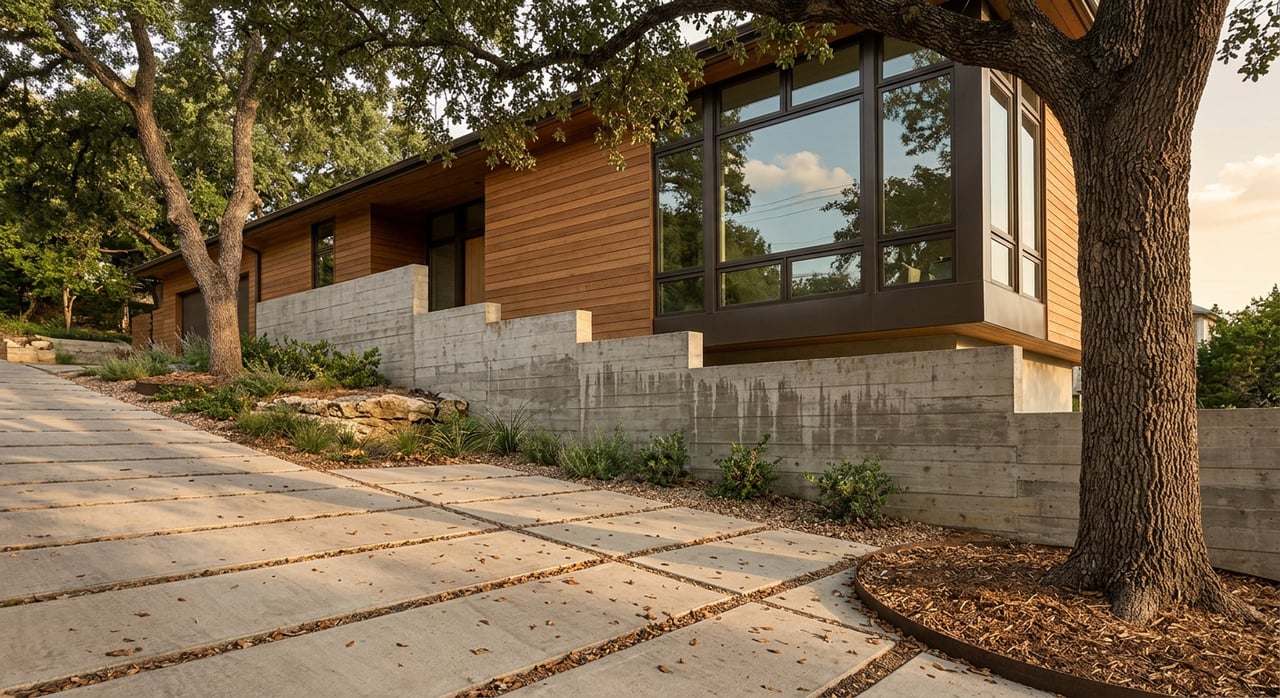
Most new builds will need a grading permit with engineered plans that show erosion controls and 2‑foot contours. The Code lists narrow exceptions for truly incidental excavations, like shallow cuts under 2 feet or stabilized work under small volumes, but larger work requires engineering and permits. In required building setbacks, excavation or fill above 18 inches is prohibited without a variance, and retaining or free‑standing walls cannot exceed 6 feet above natural grade. See the City’s site disturbance and wall standards in the construction code and the common grading exceptions in the permit section.
Driveway constraints and access
Driveways are limited to undeveloped slopes less than 25 percent under the subdivision rules. Long, steep drives on escarpment lots can be a show‑stopper, especially when combined with the cut and fill caps. Plan driveway alignment and profile early, and compare to the slope definitions and driveway standards in the City’s subdivision rules.
Drainage and erosion controls
Your plans must show temporary and permanent best management practices, and the City requires certification of completion before final acceptance or a certificate of occupancy. The Drainage Manual ties thresholds to state stormwater permits, which adds design detail on many projects. Budget a civil engineer and erosion control line items as part of the build cost. The requirements and submittal expectations are outlined in the City’s erosion and stormwater provisions and the Drainage Manual.
Trees, oak wilt, and replacement costs
Tree surveys and measures
Before many permits or variances, the City requires a tree survey. The survey must identify species, location, and trunk diameter, and must include all trees with trunk diameters of 3 inches or greater measured at 12 inches above ground for the survey. Some removal thresholds use measurements at 54 inches above ground, so confirm the correct measurement point for your application type. See survey and measurement requirements in the Tree Preservation Ordinance.
Removal and replacement rules
Plan for removal permits and replacement inches if your build zone crosses protected trees.
- Trees under 10 inches in diameter (measured at 54 inches above ground) may be removable with a no‑fee permit once per calendar year in some cases.
- Trees 10 inches to under 14 inches may be removable with permit under stricter criteria or may require a variance.
- Trees 14 inches and larger generally require a variance, with 150 percent caliper‑inch replacement required. Trees 6 inches to under 14 inches generally require 75 percent replacement, and diseased or dying trees may carry a 50 percent replacement obligation.
- If the site cannot accommodate the replacement inches, the City often allows cash‑in‑lieu based on a per‑caliper schedule. Examples in the ordinance list $150 per caliper inch for 10 to under 14 inches, $200 per caliper inch for 14 inches and larger, and $500 per caliper inch for unauthorized removal. Full details are in the Tree Preservation Ordinance.
Oak wilt inspections
Subdivision and some development applications require a formal oak wilt inspection or certification. Projects with live oak or red oak species should budget time for inspection, potential seasonal pruning restrictions, and mitigation measures if disease is present nearby. The City’s oak wilt provisions are enforced and can affect scheduling. Review the certification and enforcement framework in the oak wilt ordinance.
Variance triggers to expect
Some designs need extra review or Council or ZAPCO action. Common triggers include removal of trees 14 inches and larger, cut or fill that exceeds the Drainage Manual limits or grading beyond 18 inches within setbacks, and impervious cover exceedance above your allowed percentage. Driveways that require grades at or above 25 percent and lots impacted by the Edwards Aquifer Recharge Zone or septic design reviews also raise the bar. You can review these triggers in the Tree Preservation Ordinance, the Drainage Manual, the dimensional schedule, and the subdivision rules.
Approval path and timing
A typical path looks like this: pre‑application meeting with Development Services, then civil and site plan submittal that includes grading and drainage, tree survey, and topography. The City performs engineering and tree reviews, then issues building and grading permits. Expect inspections during construction for erosion controls and a final acceptance step at completion. The City provides checklists and encourages pre‑application meetings to reduce surprises; plan for several weeks for initial review cycles and more time if variances are needed. Start with the City’s Building and Development page for process guidance.
Fast feasibility checklist
Use this checklist on a site visit or as an offer contingency:
- Recorded plat, boundary survey, and a current topo with 2‑foot contours.
- Permit history to spot open work or prior driveway or grading approvals.
- Tree baseline: quick arborist memo listing all trees 10 to 14 inches and noting any oak wilt symptoms.
- Sewer status: confirm City wastewater connection if you plan to rely on an impervious bonus.
- FEMA floodplain and mapped drainages across or near the lot.
- High‑level cut and fill estimate: compare your conceptual pad and driveway profile to Table 7‑1. If any slope segments exceed 35 percent, treat the site as high risk.
Position your project
- Walk the lot with a licensed surveyor and an arborist to confirm topography, major trunks, and any disease indicators.
- Run quick impervious math against the City schedule. For sub‑half‑acre lots, use the small‑lot example and verify with the City.
- Sketch a driveway alignment and grade profile early. Confirm it stays under 25 percent and fits the cut and fill limits.
- If feasibility is tight, schedule a pre‑application meeting with Development Services. Bring your concept, tree data, and any early engineering.
- Prepare for a full tree survey, grading and erosion control plan, and a variance package if needed. Show mitigation and clear hardship where you ask for relief.
When to walk away
Some constraints are expensive to overcome or cannot be approved. Red flags include lots with broad slope areas over 35 percent, multiple protected trees 14 inches or larger in the intended build zone, no access to City sewer where your design needs an impervious cover bonus, and site access that would require a driveway grade at or above 25 percent. Any one of these can force a redesign or a costly variance strategy. If two or more are present, treat the site as a high‑risk acquisition.
Buying land in West Lake Hills rewards preparation. When you translate percentages to square feet, test your slopes against Table 7‑1, and map your trees by size, you will know quickly if a lot fits your program. If you want a clear path from lot walk to permit with local insight on entitlements and luxury build expectations, connect with Courtney Hohl to Book a Private Market Consultation.
FAQs
What zoning districts cover most West Lake Hills homes?
- You will likely see R‑1, R‑2, or R‑3, each with specific minimum lot sizes, setbacks, heights, and floor‑area rules, summarized in the City’s dimensional schedule.
How do you calculate impervious cover on a 0.25‑acre lot?
- Multiply the lot area by the allowance from the City’s small‑lot example, which is 37.5 percent at 0.25 acre, yielding about 4,083 square feet of total impervious area per the dimensional schedule.
Do permeable pavers reduce impervious cover here?
- Not by default; the City typically counts permeable pavers and compacted gravel as 100 percent impervious unless a specific system is accepted, as defined in the subdivision rules.
What are the key slope cut and fill limits?
- The Drainage Manual limits open and closed cuts and fills by slope band, and prohibits any cut or fill on slopes over 35 percent, summarized in Table 7‑1 of the Drainage and Erosion Control Manual.
When is a grading permit required for a new home?
- Most projects need a grading permit with engineered plans; only narrow exceptions for small, incidental excavations apply, per the City’s grading permit rules.
What trees require a variance to remove?
- Trees 14 inches and larger generally require a variance and carry a 150 percent replacement obligation measured in caliper inches, described in the Tree Preservation Ordinance.
What is the driveway slope limit in West Lake Hills?
- Driveways must be located on slopes under 25 percent, which is why drive alignment and length should be tested early, per the subdivision rules.